J M Blashfield Buff Terracotta Winged Harpy Urn c.1860
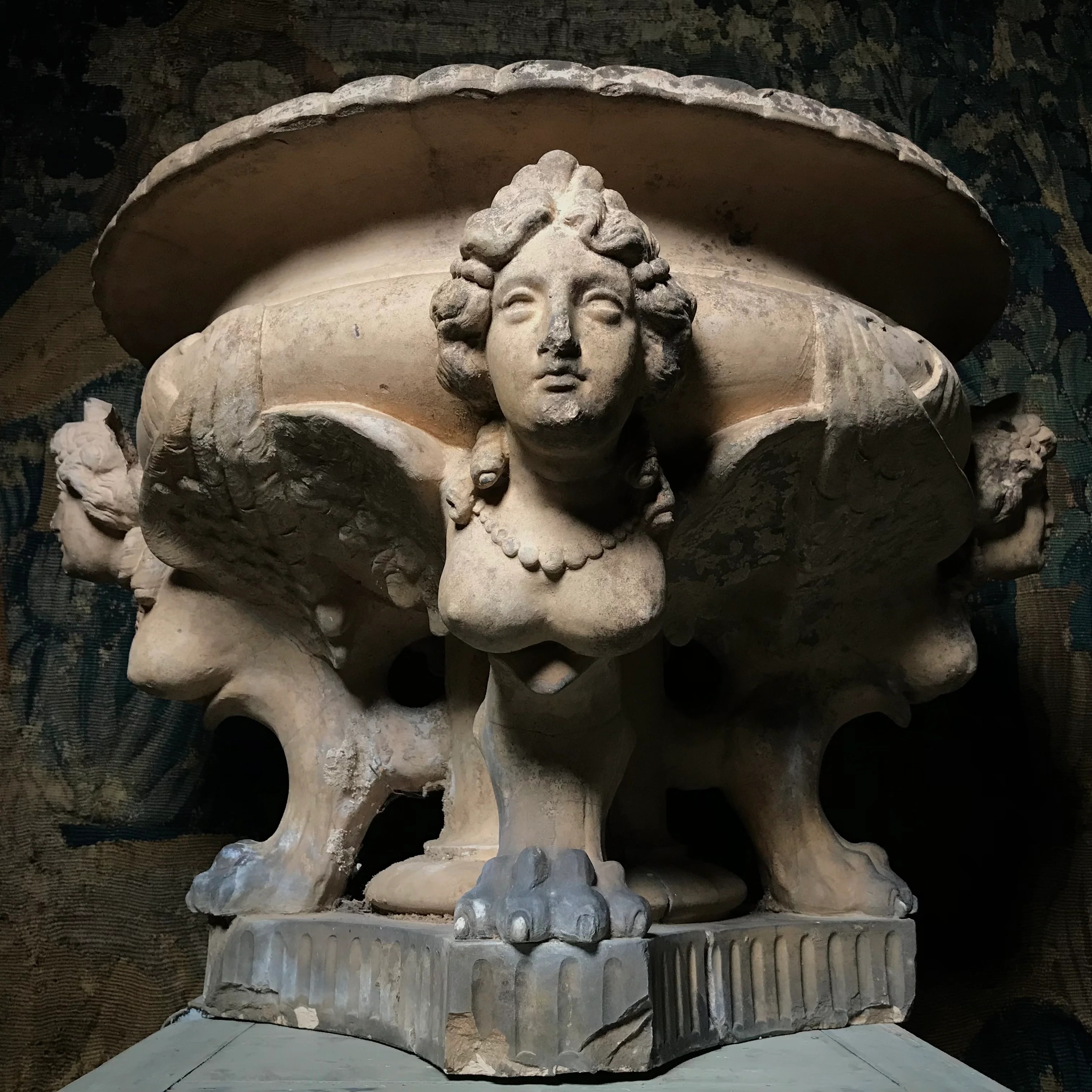
An incredibly rare example of a terracotta urn depicting four mythical Harpies, attributed to John Marriott Blashfield c.1860.
The four bear-breasted winged Harpies, sit linking their wings, at the four corners of the turned waisted socle, on a squared shaped fluted plinth.
John Marriott Blashfield, remarked in his essay Account of the History and Manufacture of Ancient and Modern Terracotta (1855) that he had been inspired to make a kind of artificial stoneware after seeing the pieces for which Mark Blanchard, the leading terracotta ornamentalist of the mid-19th century who had trained at the Coade manufactory, had been awarded prizes at the Great Exhibition of 1851.
In his catalogue “Selection of vases, statues, busts, from Terra-cottas” by Blashfield, J. M. (John Marriott) Publication date 1857 many similarities can be found in examples which relate to the Classical influence of this piece.
The urn has wear and patina appropriate to age, in addition to original firing cracks. But nonetheless taking away from the rarity and imaginative design of this highly unique piece of English terracotta history.


Description
An incredibly rare example of a terracotta urn depicting four mythical Harpies, attributed to John Marriott Blashfield c.1860.
The four bear-breasted winged Harpies, sit linking their wings, at the four corners of the turned waisted socle, on a squared shaped fluted plinth.
John Marriott Blashfield, remarked in his essay Account of the History and Manufacture of Ancient and Modern Terracotta (1855) that he had been inspired to make a kind of artificial stoneware after seeing the pieces for which Mark Blanchard, the leading terracotta ornamentalist of the mid-19th century who had trained at the Coade manufactory, had been awarded prizes at the Great Exhibition of 1851.
In his catalogue “Selection of vases, statues, busts, from Terra-cottas” by Blashfield, J. M. (John Marriott) Publication date 1857 many similarities can be found in examples which relate to the Classical influence of this piece.
The urn has wear and patina appropriate to age, in addition to original firing cracks. But nonetheless taking away from the rarity and imaginative design of this highly unique piece of English terracotta history.