‘Isabelline’ Pomegranate Finial from Granada c.1500-1520
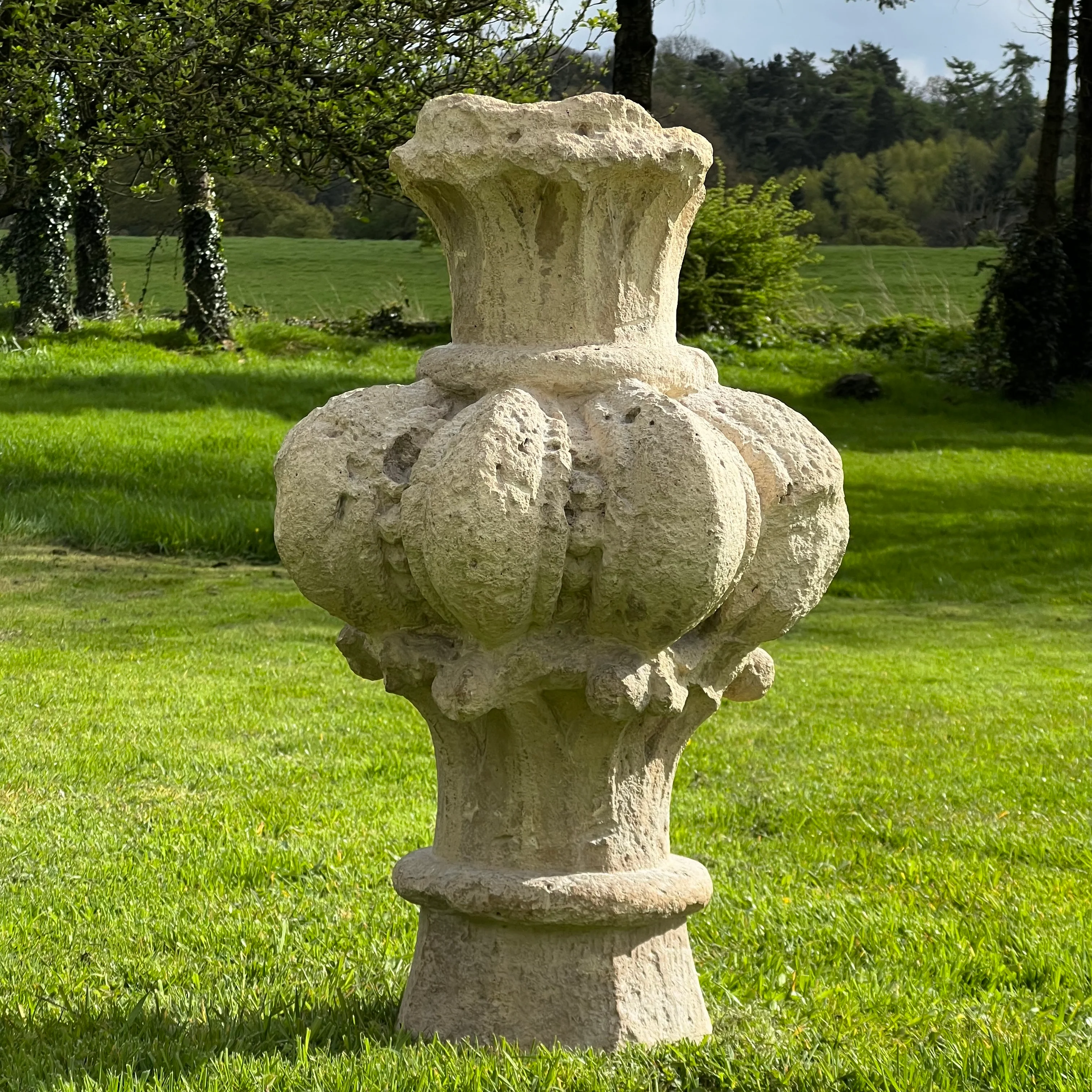
This divine sculptural Pomegranate Form Finial was created in the early 16th Century c.1500-1520, hand-carved from the warm distinctive “Santa Pudia” calcarenite stone of the Granada region of Andalusia.
The wonderfully naturalistic element takes the form of a crowned cluster of ripe pomegranates bursting open and displaying their beaded seeds.
Distinctively carved in the ‘Isabelline’ style, known as Isabelline Gothic, or Castilian late Gothic.
The finial was likely part of an important historical building set within its external architecture, is obvious pomegranate motif making it an essential integrated symbol if the uniquely Flamboyantand decorative Isabelline style which was the dominant architectural style of the Crown of Castile, Queen Isabela I of Castile and King Ferdinand II of Aragon. Similar examples can be found in the exterior architecture of The Royal Chapel of Granada.
Isabelline style spanned the transition between late Gothic and early Spanish Renaissance architecture. A fusion of influences: from ‘Modern’ - Castilian tradition, Flemish and Mudéjar; to the ‘Roman’ - the sensual neoclassical style of Italian Renaissance architecture.
The most obvious characteristic was the use of heraldic and epigraphic emblems-especially the yoke and arrows (representing a united Spain) and the pomegranate as seen here (representing the Catholic Monarchs final victory over the Moors of Al-Andalus), along with the use of beaded motifs of orbs.
“Santa Pudia” calcarentie stone, of which the finial is carved from, was extracted from quarries from Granada, is was a very important ornamental stone used to make windows, cornices, finials and balustrades in some of the main historical buildings in Andalusia, particularly Granada. Notable buildings include The Royal Chapel, San Juan de Dios monastery and the Royal Chancery or Carlos V Palace in the Alhambra.
Display as an ancient fragment or use as a fountain head in your garden space, or as an object of art within your interior.
Original: $5,056.17
-70%$5,056.17
$1,516.85




Description
This divine sculptural Pomegranate Form Finial was created in the early 16th Century c.1500-1520, hand-carved from the warm distinctive “Santa Pudia” calcarenite stone of the Granada region of Andalusia.
The wonderfully naturalistic element takes the form of a crowned cluster of ripe pomegranates bursting open and displaying their beaded seeds.
Distinctively carved in the ‘Isabelline’ style, known as Isabelline Gothic, or Castilian late Gothic.
The finial was likely part of an important historical building set within its external architecture, is obvious pomegranate motif making it an essential integrated symbol if the uniquely Flamboyantand decorative Isabelline style which was the dominant architectural style of the Crown of Castile, Queen Isabela I of Castile and King Ferdinand II of Aragon. Similar examples can be found in the exterior architecture of The Royal Chapel of Granada.
Isabelline style spanned the transition between late Gothic and early Spanish Renaissance architecture. A fusion of influences: from ‘Modern’ - Castilian tradition, Flemish and Mudéjar; to the ‘Roman’ - the sensual neoclassical style of Italian Renaissance architecture.
The most obvious characteristic was the use of heraldic and epigraphic emblems-especially the yoke and arrows (representing a united Spain) and the pomegranate as seen here (representing the Catholic Monarchs final victory over the Moors of Al-Andalus), along with the use of beaded motifs of orbs.
“Santa Pudia” calcarentie stone, of which the finial is carved from, was extracted from quarries from Granada, is was a very important ornamental stone used to make windows, cornices, finials and balustrades in some of the main historical buildings in Andalusia, particularly Granada. Notable buildings include The Royal Chapel, San Juan de Dios monastery and the Royal Chancery or Carlos V Palace in the Alhambra.
Display as an ancient fragment or use as a fountain head in your garden space, or as an object of art within your interior.