Zinc Statue of the Praying Boy of Rhodes c.1860
A charming rendition of the Greek Hellenistic Praying Boy of Rhodes 300 BC. The original of which is now housed in the Altes Museum, Berlin.
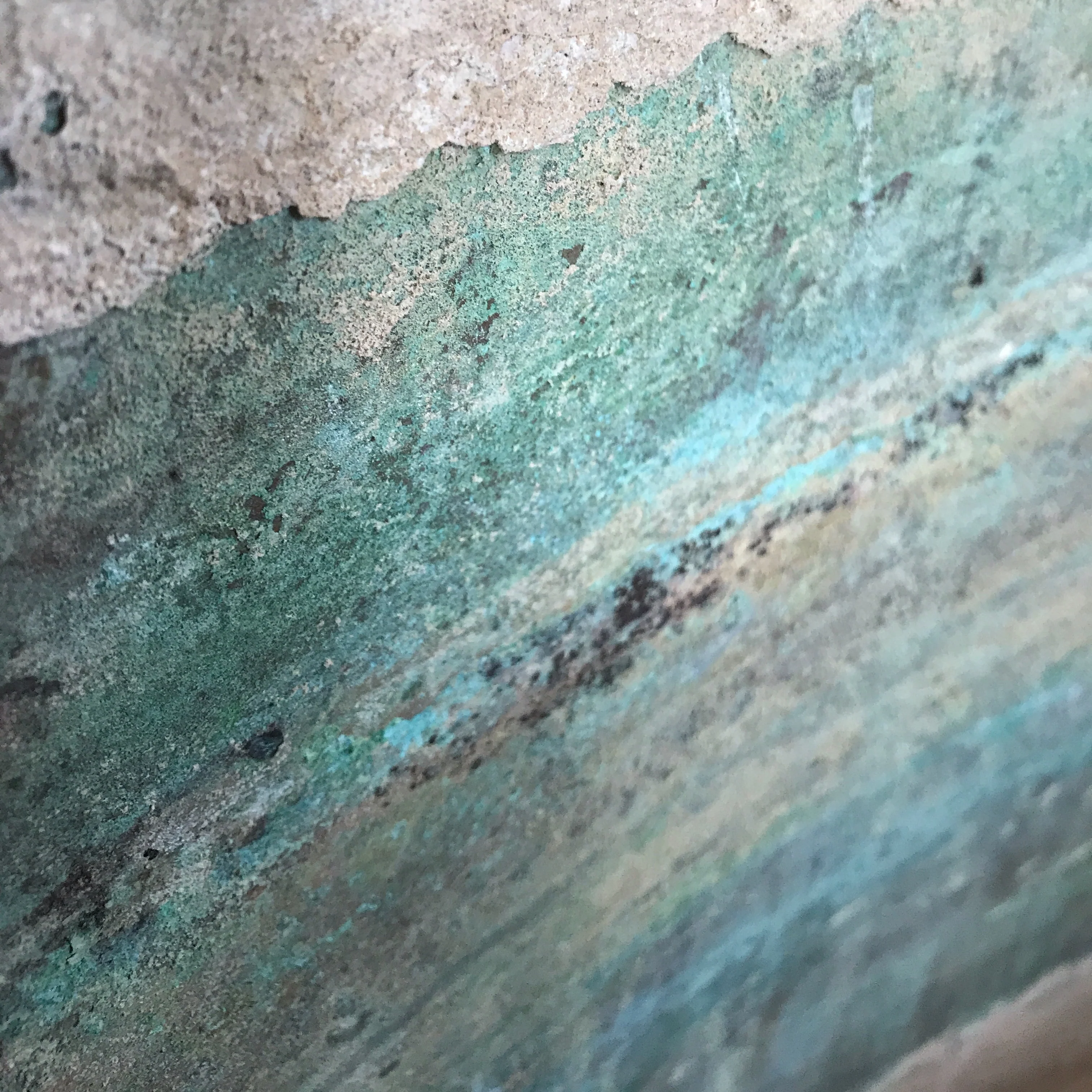
Created in zinc. The statue was possibly cast by the Berlin founders M. Geiss, who exhibited a bronzed zinc cast of stags in the 1851 Great Exhibition in London. The sculpture has a number of historical repairs and is mounted on a painted wooden plinth. It’s zinc surface is clearly visible after probably being placed outdoors for many years, creating a wonderfully rich patina elemental corrosion exposing and pitting the grey-coloured zinc. A similar collection of zinc statues by the maker M.Geiss were acquired in 1850 by Queen Victoria, can be found at the Royal Osborne House on the Isle of Wight.
Zinc sculptures like this were produced for a small time period in Britain, America, Germany and France between 1860-1900.
The boy is now thought to represent Apollo or Ganymede who Zeus abducted and brought to Olympia because of his beauty. The interpretation as a boy praying is derived because of the positioning of his arms, which were not original to the Greek sculpture.
Originally found in Rhodes when the city walls were being constructed, in 1503 the statue was taken to Venice and received great interest from the art world.
It became a highlight piece of a number of collections including King Charles I of England. Foucquet, Louis XIV’s finance minister was responsible for the arms, commissioning them to be replaced in order to display the statue in Château de Vaux-Le-Vicomte. In 1806 the piece was seized by Napoleon and became one of the most important works in the Musée Napoléon in Paris.
Original: $11,442.90
-70%$11,442.90
$3,432.87


Description
A charming rendition of the Greek Hellenistic Praying Boy of Rhodes 300 BC. The original of which is now housed in the Altes Museum, Berlin.
Created in zinc. The statue was possibly cast by the Berlin founders M. Geiss, who exhibited a bronzed zinc cast of stags in the 1851 Great Exhibition in London. The sculpture has a number of historical repairs and is mounted on a painted wooden plinth. It’s zinc surface is clearly visible after probably being placed outdoors for many years, creating a wonderfully rich patina elemental corrosion exposing and pitting the grey-coloured zinc. A similar collection of zinc statues by the maker M.Geiss were acquired in 1850 by Queen Victoria, can be found at the Royal Osborne House on the Isle of Wight.
Zinc sculptures like this were produced for a small time period in Britain, America, Germany and France between 1860-1900.
The boy is now thought to represent Apollo or Ganymede who Zeus abducted and brought to Olympia because of his beauty. The interpretation as a boy praying is derived because of the positioning of his arms, which were not original to the Greek sculpture.
Originally found in Rhodes when the city walls were being constructed, in 1503 the statue was taken to Venice and received great interest from the art world.
It became a highlight piece of a number of collections including King Charles I of England. Foucquet, Louis XIV’s finance minister was responsible for the arms, commissioning them to be replaced in order to display the statue in Château de Vaux-Le-Vicomte. In 1806 the piece was seized by Napoleon and became one of the most important works in the Musée Napoléon in Paris.